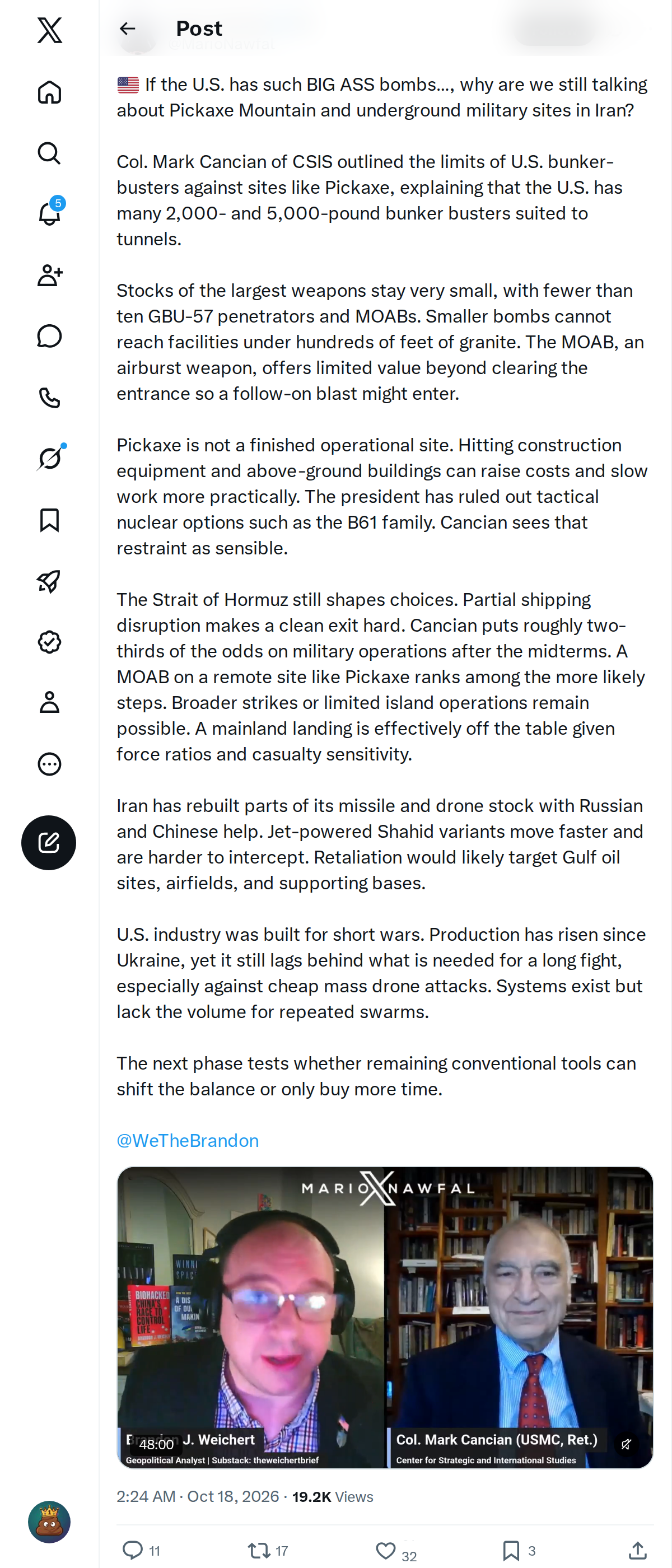
🇺🇸 If the U.S. has such BIG ASS bombs…, why are we still talking about Pickaxe Mountain and underground military sites in Iran?
Col. Mark Cancian of CSIS outlined the limits of U.S. bunker-busters against sites like Pickaxe, explaining that the U.S. has many 2,000- and 5,000-pound bunker busters suited to tunnels.
Stocks of the largest weapons stay very small, with fewer than ten GBU-57 penetrators and MOABs. Smaller bombs cannot reach facilities under hundreds of feet of granite. The MOAB, an airburst weapon, offers limited value beyond clearing the entrance so a follow-on blast might enter.
Pickaxe is not a finished operational site. Hitting construction equipment and above-ground buildings can raise costs and slow work more practically. The president has ruled out tactical nuclear options such as the B61 family. Cancian sees that restraint as sensible.
The Strait of Hormuz still shapes choices. Partial shipping disruption makes a clean exit hard. Cancian puts roughly two-thirds of the odds on military operations after the midterms. A MOAB on a remote site like Pickaxe ranks among the more likely steps. Broader strikes or limited island operations remain possible. A mainland landing is effectively off the table given force ratios and casualty sensitivity.
Iran has rebuilt parts of its missile and drone stock with Russian and Chinese help. Jet-powered Shahid variants move faster and are harder to intercept. Retaliation would likely target Gulf oil sites, airfields, and supporting bases.
U.S. industry was built for short wars. Production has risen since Ukraine, yet it still lags behind what is needed for a long fight, especially against cheap mass drone attacks. Systems exist but lack the volume for repeated swarms.
The next phase tests whether remaining conventional tools can shift the balance or only buy more time.
@WeTheBrandon tweetkeep