Listen carefully, you Qatar-worshipping peddler of Jew-erasure propaganda.
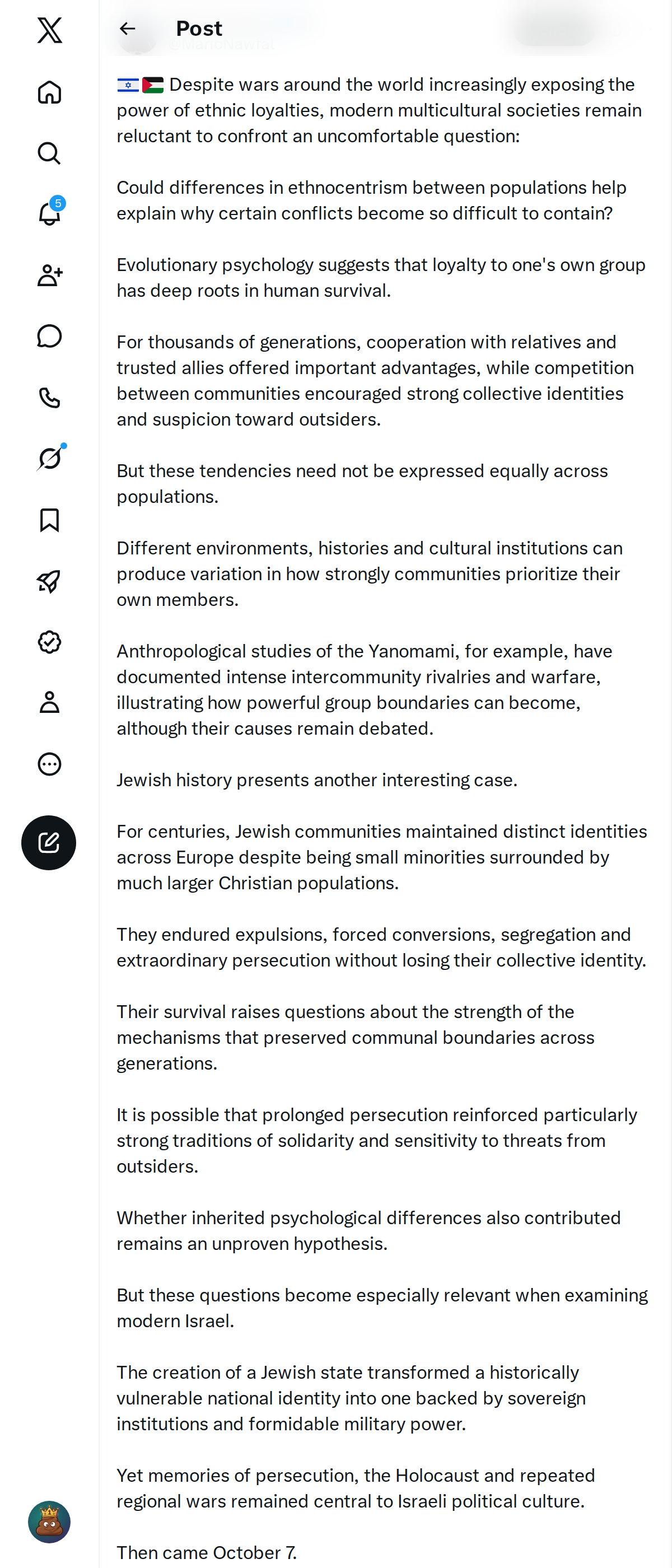
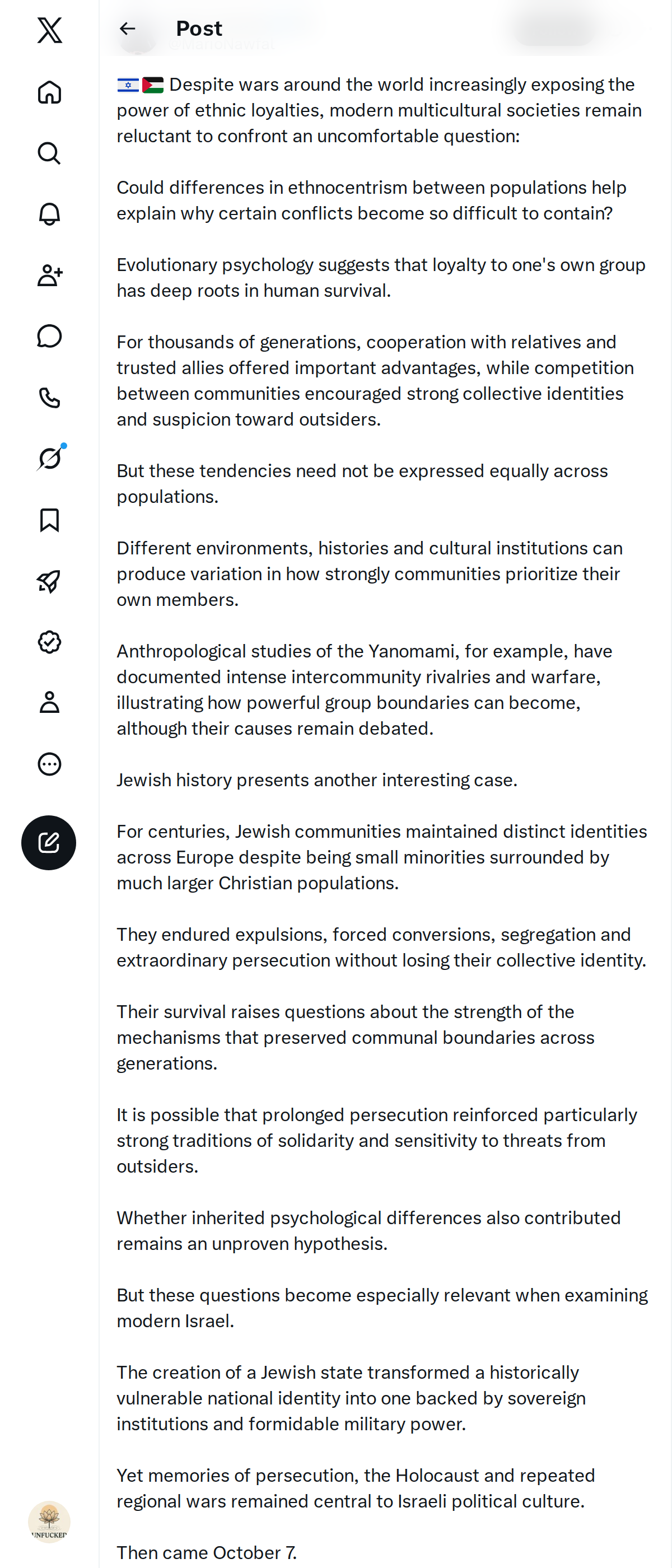
Your post advances a selectively assembled evolutionary-psychology and historical-trauma thesis that falsely casts Israeli military responses after October 7 chiefly as the outgrowth of unusually intense Jewish ethnocentrism, collective identity, and heightened sensitivity to persecution.
It then inquires whether stronger in-group loyalty, hardened by centuries of minority status and persecution, renders certain Israeli constituencies more ready to absorb high military and humanitarian costs and less receptive to compromise, thereby heightening the risk of broader escalation with Iran.
However, the framing is analytically one-sided and applied with blatant asymmetry.
The argument systematically ignores the primary, explicitly declared drivers on the opposing side: eliminationist ideology, religiously grounded rejection of Jewish sovereignty, documented military tactics that maximize civilian harm on both sides, and a long record of leadership refusal of any compromises that could produce a Palestinian state alongside a secure Jewish one.
Ethnocentrism and group solidarity are near-universal human traits shaped by history and environment.
They do not uniquely explain why one conflict proves especially intractable when one party’s core texts and educational systems treat the other’s existence as illegitimate and deserving of annihilation.
Hamas’s Covenant and official statements frame the conflict in explicitly religious and eliminationist terms.
They describe the struggle against “the Jews” as the ultimate objective that permits no room for compromise, and present violent jihad as compulsory in the face of Jewish “usurpation” of Palestine.
The 2017 “General Principles and Policies” document softened some language of the original 1988 covenant, stating the conflict is with the “Zionist project” rather than Jews as such, yet retained the core rejection: no recognition of the legitimacy of the Zionist entity, insistence on full liberation of Palestine “from the river to the sea.”
Senior Hamas figures have repeatedly clarified that the original principles remain operative and that temporary arrangements do not constitute acceptance of Israel’s existence.
Iranian Supreme Leaders have been equally direct.
Ali Khamenei has repeatedly spoken of the Zionist “cancerous tumor,” the need to eliminate the “Zionist criminal gang” from Palestine, and made it explicitly clear that the Islamic Republic will continue arming and funding every terrorist proxy in the region with the sole purpose of striking Israel until its complete destruction.
The Islamic Republic’s open and declared support for proxies (Hamas, Hezbollah, Palestinian Islamic Jihad, Houthis) whose operational doctrine centers on Israel’s destruction is by itself a declaration of war against Israel.
This is not ordinary interstate rivalry. It is a regime-level ideological commitment rooted in Khomeinist revolutionary doctrine that treats the Jewish state as an illegitimate imposition on historically Islamic land.
The post’s emphasis on Israeli willingness to accept “enormous military and humanitarian costs” inverts the deliberate strategy of the adversary.
Hamas and allied groups have constructed hundreds of kilometers of tunnels under civilian areas, used hospitals, schools, and mosques for military purposes, and treated their own population as both human shields and a political resource.
Concrete and materials that could have built civilian shelters and better infrastructure were diverted to military ends.
Hamas leadership has repeatedly prioritized the continuation of armed capability and the narrative of resistance over civilian welfare.
This is an ideology that frames martyrdom and the long-term erasure of the Jewish state as higher values than Palestinian state-building or prosperity in the present.
Hamas adheres to a specific Salafist-Muslim Brotherhood tradition in which Israel’s existence is not merely a geopolitical problem but a cosmic affront whose removal justifies extreme measures, including suicide bombings, massacres of innocent civilians, and the unlimited sacrifice of Palestinian lives on the altar of that jihadist project.
Palestinian public opinion, as measured by the Palestinian Center for Policy and Survey Research (PCPSR), has shown unyielding support for armed struggle(with no distinction between combatants and noncombatants)throughout its entire history, compounded by either denial that Hamas committed the documented atrocities of October 7 against civilians or the celebration of those atrocities, and the almost nonexistent attributions of humanity to the other side among the Palestinian population.
This is what perpetuates the conflict, not Israel’s supposed willingness to accept “enormous military and humanitarian costs.”
Early post-October 7 polls recorded majority approval of the decision to launch the attack.
Support for armed methods against random innocent Jewish civilians (commonly known as terrorist attacks) has fluctuated but remains significant, both in the West Bank and Gaza, and large majorities have opposed disarming Hamas as a precondition for ending hostilities.
The dehumanization of Israelis among the Palestinian population is overwhelming and extreme: the vast majority of the Palestinian population both in Gaza and the West Bank (though to a lesser extent in the West Bank) assign near-zero humanity status to Jews in Israel.
This is precisely the reason why a terrorist attack by a Palestinian against random innocent Jewish civilians almost never produces any condemnation from Palestinian voices, whereas the extremely rare occasion of a terrorist attack by an Israeli against Palestinians produces unequivocal condemnation from almost all parties in Israel.
The best example for that is Baruch Goldstein, regarded as a terrorist by the majority of Israelis and unequivocally condemned by almost all Israeli people, whereas countless Palestinian terrorists who committed similar acts against random innocent Jewish civilians are routinely exalted and praised in Palestinian society and almost never condemned.
Educational systems under the Palestinian Authority and UNRWA have long been documented by monitors such as IMPACT-se as containing persistent content that erases Israel from maps, glorifies “martyrs” who carried out massacres or terrorist attacks against random civilians (including children), propagates the most extreme antisemitic tropes, dehumanizes Israelis and Jews in general, and presents jihad and violence against random innocent Jewish civilians as religious and national virtues, not just as recommended but as a duty of Palestinians to carry out.
Recent textbook analyses found that no changes were made to such curricula despite external reform pressures.
The distinguished Dr Einat Wilf alongside many reputable academics have argued that Palestinian national identity, heavily shaped in UNRWA institutions, fused Arab-Islamic denial of Jewish equality and historical connection to the land with imported European and Soviet antisemitic themes.
The result is a political culture in which the “right of return” of millions of descendants into pre-1967 Israel functions as a mechanism for demographic elimination of the Jewish state rather than a negotiated end-of-conflict refugee settlement.
Dr Wilf has repeatedly noted that Palestinian support for a “two-state” formula that retains an unrestricted “right of return” is, in practice, support for an Arab state in the West Bank/Gaza plus the replacement of Israel, not acceptance of a Jewish state.
Palestinian leadership under both the PLO/PA and Hamas have outright rejected successive Israeli offers (including Camp David 2000 and the Olmert parameters) that would have produced a Palestinian state.
They rejected the offers because those offers required them to recognize the Jewish state’s permanence, to announce an end to the conflict, and to be willing to compromise on the so-called “right of return.”
Official “pay-for-slay” stipends and glorification of terrorists further institutionalize the preference for terrorism over compromise.
In the radical Islamist framework dominant in Hamas (Muslim Brotherhood lineage) and the Iranian regime, Jews are not regarded as a national group with equal rights to sovereignty.
Traditional Islamic jurisprudence classifies Jews as a mere religious community with no national or ethnic components.
Modern radical Islamists, including the Muslim Brotherhood and Khomeinists, escalate this to active hostility against any Jewish political power in lands once under Islamic control (Dar al-Islam).
The Land of Israel/Palestine holds special religious status in Islam.
This produces a zero-sum view in which Jewish self-determination is not a negotiable political claim but an affront.
The post’s evolutionary-psychology lens notes Jewish historical boundary-maintenance under persecution.
It does not equally examine how Islamic doctrinal categories and modern Palestinian nationalism have produced an eliminationist form of collective identity.
Every nation-state prioritizes its own survival. Israeli political culture is partially shaped by historical persecutions(chief among them the Holocaust), expulsions from Arab countries, repeated wars of annihilation launched against it, and the explicit Palestinian rejectionism just described.
Trauma and strong collective identity influence domestic politics.
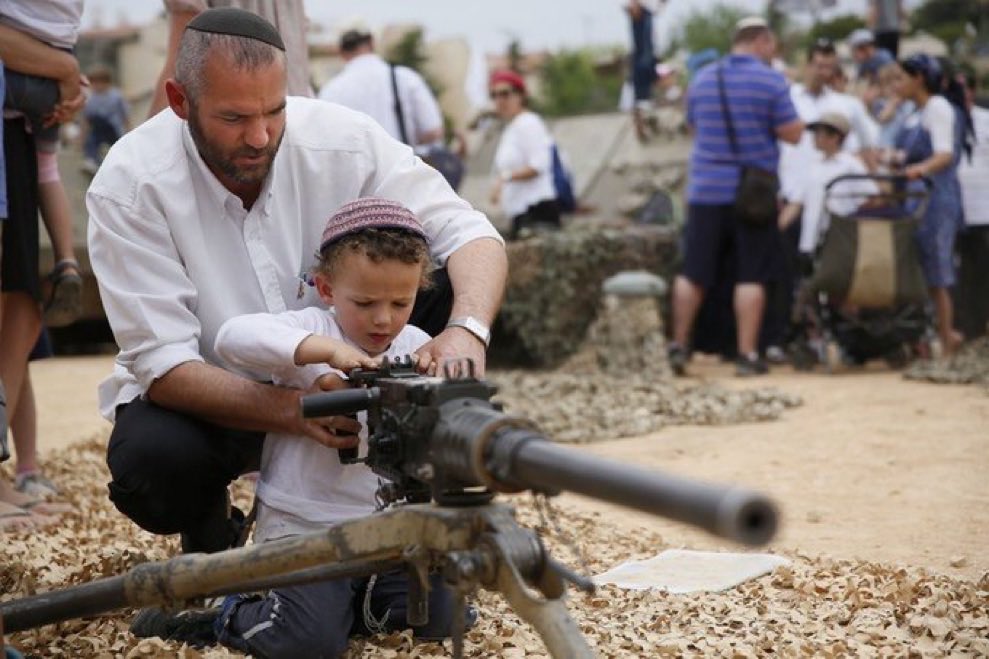
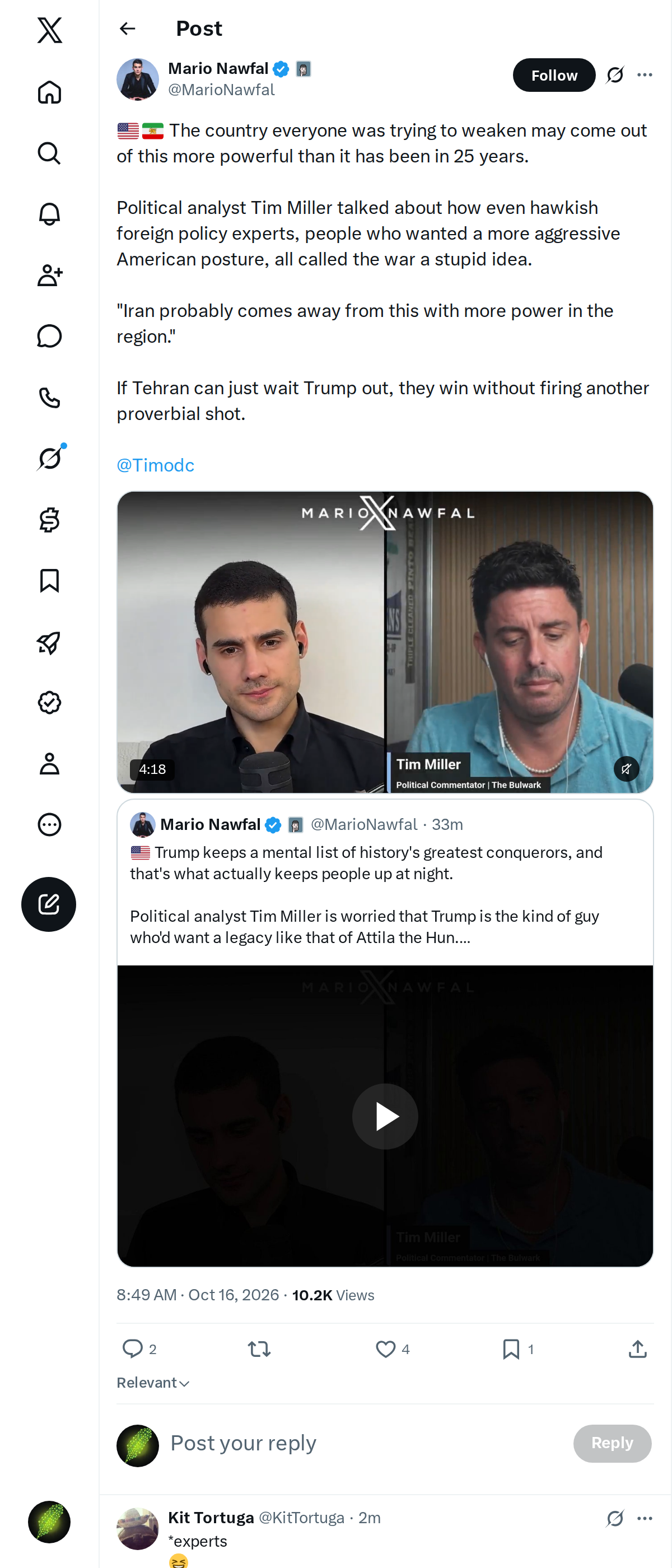
Hardline ministers and settlement maximalists exist, as the video highlights, and can complicate compromise.
Yet the same can be said of many conflict-affected societies.
The distinctive feature here is not an unusually high Jewish “ethnocentrism coefficient” but the sustained refusal of Palestinian leadership and regional actors to accept any permanent Jewish sovereignty in the territory, combined with military methods that deliberately collapse the civilian-combatant distinction.
Israel has relinquished land nearly three times its own size in pursuit of peace; beyond securing peace and harmony with its neighbors, there existed no other advantage for Israel in relinquishing the entire Sinai Peninsula to Egypt.
Israel has withdrawn from Gaza in a unilateral disengagement to which the response has been further militarization and rejection rather than reciprocal state-building.
Your post correctly notes that escalation can deepen hostility and that regional confrontation with Iran carries wider risks.
It does not, however, establish that the primary causal variable is Israeli collective identity rather than the adversary’s declared and operationalized goal of Israel’s elimination, the educational and cultural transmission of that goal, and the tactical choices that force high civilian costs in any serious military response.
Treating the latter as secondary hypotheses while centering the former produces a distorted and deceptive causal account.
The principal engine of the never-ending conflict has been the long-standing rejection of the legitimacy of Jewish national existence in the land, not an excess of ethnocentrism.
 tweetkeep